Active Participation... Thoughts
I was out to dinner with a family from the parish I am staying at, and they love to ask me questions about everything, especially the more traditional aspects of the Catholic faith. The mother passed me an old booklet that had something to do with Medjugorje, but thankfully they weren't asking about the events themselves because that is a can of worms that I haven't personally opened. Inside this booklet, there was a list of benefits of "assisting" at Holy Mass. I found a list online that is very similar, and it goes like this:
- The Mass is Calvary continued.
- Every Mass is worth as much as the sacrifice of Our Lord's life, sufferings and death.
- Holy Mass is the most powerful atonement for your sins.
- At the hour of death the Masses you have heard will be your greatest consolement.
- Every Mass will go with you to judgement and plead for pardon.
- At Mass you can diminish more or less temporal punishment due to your sins, according to your fervor.
- Assisting devoutly at Holy Mass you render to the humanity of Our Lord the greatest homage.
- He supplies for many of your negligences and omissions.
- He forgives the venial sins which you have not confessed. The power of Satan over you is diminished.
- You afford the souls in Purgatory the greatest possible relief.
- One Mass heard during life will be of more benefit to you than many heard for you after your death.
- You are preserved from dangers and misfortunes which otherwise might have befallen you. You shorten your Purgatory.
- Every Mass wins you a higher degree of glory in Heaven.
- You receive the Priest's blessing which Our Lord ratifies in Heaven.
- You kneel amidst a multitude of Holy Angels, who are present at the adorable Sacrifice with reverential awe.
- You are blessed in your temporal goods and affairs.
This was a fantastic list of benefits of praying the Mass. I even re-read it a couple of times at the dinner table because it was a great reminder for my own soul. However, the family had a question about what it means to "assist" at Mass. The mother innocently asked me if she needed to sign her kids up to altar serve or pass the collection baskets around in order to "assist" at Mass. One of the daughters had the right idea when she said that assisting Mass means to attend Mass. I want to expand on this idea because it is debatably the most important part of the Christian life.
Pope Pius XII said:
"It is necessary that all Christians consider their principal duty and highest dignity that of taking part in the Eucharistic sacrifice... so proudly and so actively as to be intimately united to the great High Priest... making this offering together with him and through him consecrating themselves"
(Mediator Dei, 102)
For context, he wrote this before Vatican II where the phrase "active participation" became as famous of a buzzword as "unity," "missionary disciple," and "synodality" are today.
The Second Vatican Council says:
"The Church, therefore, earnestly desires that Christ's faithful, when present at this mystery of faith, should not be there as strangers or silent spectators; on the contrary, through a good understanding of the rites and prayers they should take part in the sacred action conscious of what they are doing, with devotion and full collaboration. They should be instructed by God's word and be nourished at the table of the Lord's body; they should give thanks to God; by offering the Immaculate Victim, not only through the hands of the priest, but also with him, they should learn also to offer themselves; through Christ the Mediator, they should be drawn day by day into ever more perfect union with God and with each other, so that finally God may be all in all"
(Sacrosanctum Concilium, 48)
Why am I ranting about this?
The essence of active participation is what I think my priesthood will be aimed towards. So many people grew up in the postmodern Church thinking it was effeminate and boring. They see Holy Mass as a boring ritual where we sing some bad songs, hear a mediocre TED talk, listen to Scripture which makes no sense out of context, and share a meal consisting of a stale cracker paired with bottom shelf wine. I don't think there is a person who works in ministry today who can't relate to this or understand the stereotype, so a few different strategies have been formed to correct it. Some people focus on the genre of music and choose songs that are more prayerful whether it be praise and worship or Gregorian chant. Others think that getting everybody to say the responses with passion will help because there would a reinforcing seriousness and confidence communicated. Some think that an engaging priest who uses narrative to explain everything to the people is the key to unlocking a conscious participation. I propose that all of these solutions are notable and well intentioned, but they miss the central purpose of the Eucharistic Sacrifice according to Mediator Dei and Sacrosanctum Concilium.
If we want to conform ourselves to Christ and His teaching, it makes sense that we look to how He chose to live His life. What did he do? To put it simply, He died to the world and rose to heavenly glory. This is one of His most repeated messages, and nobody really figured it out until Pentecost. We can look to "Take up your Cross and follow me" or "If you want to have life, then lay your life down" or "If a grain of wheat dies, it produces much fruit" and many other verses from the New Testament.
Why did Christ die? It is easy to respond with the simple answer: "so us sinners can go to Heaven," but this isn't very satisfying for those who want to gain deeper understanding. Due to our sin, we have committed an infinite injustice against almighty God. If God were to pardon us for our sin, then there would be an injustice committed against God. However, this does not mean that God must inflict His righteous anger against all of humanity and throw us into eternal damnation. He also wants to be with us in Heaven forever, so how did he plan to solve this problem?
In the Old Testament, God introduced humanity to the notion of sacrificial justice. God gave very specific instructions to the Israelites regarding what animals to sacrifice in order to atone for sin. However, a finite animal can't bridge an infinite gap between God and man. This is why Jesus came and laid down His life for us. He is the Lamb of God who takes away the sins of the world. With the pleasant aroma of His sacrifice, the scales of justice have been shifted so that we not only have the bare minimum amount of grace needed to obtain salvation, but God purchased an infinite supply of grace to flow from Calvary to man.
This is precisely where the Holy Sacrifice of the Mass gains the active participation of the people. In the Holy Mass, many powerful things happen, but two stand out in this conversation. During the Eucharistic prayer, the immaculate victim (Christ) is offered to the Father in atonement for our sins and the whole world. When the body of Jesus is sacramentally split from his blood, a death of sorts takes place. In an animal sacrifice, the blood of the animal is poured out on the altar and it is separated from its flesh. This is why Jesus instituted an offering of bread and wine + body and blood. The sacramental separation of Jesus' body and blood is the spotless sacrifice we offer to the Father. (For clarification, Jesus is present with His body, blood, soul, and divinity in both of the eucharistic species. The metaphysics is very confusing and mysterious, but this is why the Catechism says we offer an "unbloody" sacrifice at Mass).
However, Sacrosanctum Concilium also evisions that we ought to offer ourselves to God the Father in union with Christ. This offering of ourselves demands quite literally every single aspect of our life and will. If God is our bridegroom and we are His bride, then we ought to make sure our union with Him is Free, Total, Faithful, and Fruitful just like every married couple promises during their wedding vows. Ever wonder why the altar server or deacon blesses the congregation with incense at the offertory? During the offertory, the incense is used to bless the gifts which are placed on the altar. The priest and people themselves are a crucial part of the sacrifice of the Mass.
It is a natural question to ask: how can I offer myself to God while at the same time offering God to God? This doesn't make sense? I think that part of this mystery can be understood in the context of who Jesus is: the God-man. From the prologue of John's Gospel, we know that Jesus is begotten by the Father and has existed for all of eternity. This means that Jesus is a divine person. It is reasonable to say that He also has a divine nature since he possesses the divine attributes of power, charity, mercy, etc. However, at some point, Jesus came to Earth and took on human flesh. This means that he also has a human nature. It is confusing, but the Church teaches that Jesus is one divine person who possesses two natures: one divine and one human. Likewise, at Mass, there are two natures to the sacrifice on the altar. The divine element is the immaculate victim while the human element is ourselves.
/////////////////////////////
Ok, so all of this covers the reason for Jesus's death to the world. So what does His resurrection have to do with us? The resurrection is also a part of Holy Mass. When the priest fractures the Host and drops part of it into the chalice, the Body and Blood of Christ are sacramentally reunited. It is at this point where we say "Behold the Lamb of God. Behold Him who takes away the sins of the world. Blessed are those who are called to the supper of the Lamb." The supper of the lamb is what the resurrection points to. It is at this point that we come forward to receive the Eucharist and all of the graces that come with it. At long last, after the bridegroom and bride have offered every single part of their lives to the other and the union is consummated. In the bodily, marital act, the bridegroom (husband) enters into the bride (wife) to produce life (a baby) in the womb. In the Mass, the bridegroom (God) enters into the bride (us) to produce everlasting life with Mother Church acting as a womb to protect and nourish us.
Going back to the image of the grain of wheat that I referenced earlier, it is essential that it must die in order for life to come forth from it. Likewise with us, we must die in order for life to come forth from us. Every single Doctor of the Church on prayer hammers this idea home over and over and over again. We must die and recognize our nothingness in order for Christ to flourish in us. If we don't die completely, then why should we expect any major life to come forth from us? Holding back from our bridegroom would be to contracept the relationship. How can a seed fertilize an egg if there is contraception in place? Likewise, how can the Eucharist pour grace into our life if we put barriers between ourselves and God? To actively participate in Mass, we need to remove every single barrier possible in our life that keeps us from God. Fortunately, frequent reception of the sacraments, obedience to our duties, and maintaining a consistent prayer life can help us to do this. None of us will enter into this participation perfectly while on Earth, but it makes the crazy stories of the saints levitating and going into ecstasy seem more rational. How were they able to do this? They simply loved God and their neighbor with all of their body, mind, soul, and strength. They let absolutely nothing stop their pursuit towards God as well as God's pursuit towards them. So the next time you are present at the foot of the Cross at the Holy Sacrifice of the Mass, unite yourself to Christ just as Our Lady did. One of her titles is co-redemtrix, not because she saved the world, but because she fully cooperated with Christ's redeeming sacrifice on Calvary.
/////////////////////////////////
This was so fulfilling to write down. I plan on writing my MA Thesis on this exact topic. I will be coming back to this at some point and digging even deeper into it. What better topic to focus my seminary studies on then the source and summit of the Christian life?
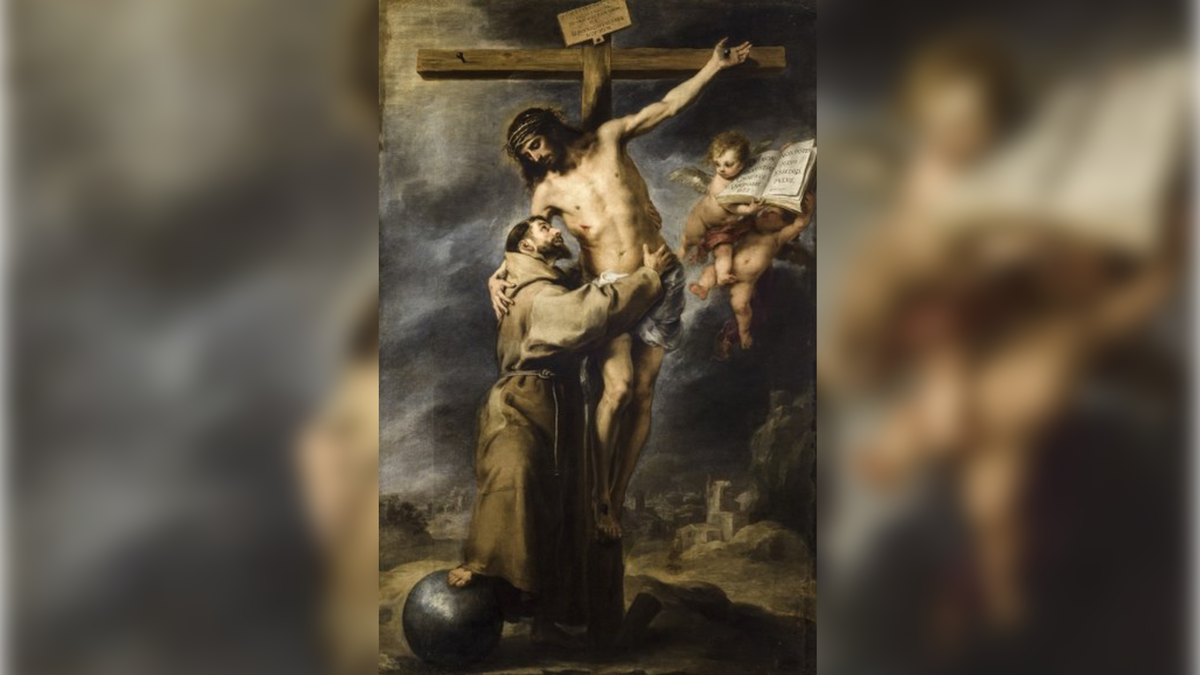
Here is a famous image of depicting St. Francis of Assisi uniting himself to Christ on the Cross. This is what it means to be in union with the God-man.