Proper Fear of God
At the time of writing this, I find myself in the late dog days of summer with a new year of seminary formation approaching. This summer has been pretty chill if I had to summarize it. Nothing bad happened, but nothing life changing happened either. If anything, my overall laxity has affected my prayer life and pursuit of virtue. I decided to get back into running as a form of exercise, and that has shifted to a full on marathon training plan. I have been less strict with my phone usage after this past lent, and now I find myself committing two sins.
1) I have found myself prioritizing my marathon training ahead of my prayer on many days
2) I waste much of my time on my phone tracking my runs alongside of my friends, meticulously watching over my data and the weather forecast, and watching hours of unnecessary YouTube videos.
I have been feeding myself the lie that serving daily Mass and reciting 2-3 sections of the Divine Office a day makes up for it. At first, I would miss maybe 1 holy hour a week, but now it has gotten to the point where if I don't intentionally plan it, I may only remember to pray my holy hour 2-3 times a week.
Why am I sharing this?
I came down with a virus of some sort yesterday, so today I wanted to feel a bit better about myself and actually attempt to read a book instead of stare at my screen all day. This summer I started reading "Dignity and Duties of the Priest" by St. Alphonsus Liguori. I thought that it would be a book that would inspire me with consolation, but so far it has done the opposite. It is quite literally terrifying me.
I was initially aware that the Church today doesn't seem to revere the office of the priesthood as much as it used to, and it is easy to complain about it. However, I never really thought about the other side of the coin. With great power comes great responsibility, and no earthly position of power has more responsibility than being a cleric.
It is important to remember the context of the Church that St. Alphonsus was writing in. This was before St. Therese the Little Flower or St. Faustina shared their "teachings" of God's divine mercy, but those teachings still shouldn't water down how terribly offensive sin is against almighty God. For St. Alphonsus, the battle between virtue and vice is at even greater stakes for the priest. I am only 60 or so pages into the 300 page book, but I can already see how he is writing about this.
For a normal person, it is a generally accepted rule of thumb that as long as one avoids mortal sin, they will be saved on the last day. Even if they fall into mortal sin, the sacrament of confession will restore them to a state of sanctifying grace. For priests, because of the spiritual warfare involved, it is different. The enemy so badly wants to damn a priest that he will put one hundred times more effort into tempting a priest of lukewarm faith than a lay person of lukewarm faith. St. Alphonsus is so worried about this that he says if a priest commits what would normally be a venial sin, he ought to treat it as a mortal sin. If he commits what normally would be a mortal sin, then he may be lost forever.
Now, is St. Alphonsus denying that God would forgive a priest of a mortal sin? No. Is he denying that God would deny a priest the graces necessary to rebuild a life of virtue? No. However, a mortal sin committed by a priest is infinitely more offensive than a sin committed by a lay person.
It gets even worse.
If a priest were to offer the Holy Sacrifice Mass in a state of mortal sin, it would be less blasphemous to throw a consecrated host into a sink or flush it down a toilet. He even goes as far as to say that it would be a worse sin than the betrayal of Judas for two reasons: 1) Judas gave Jesus over to the persecuting Jews while a mortally sinful priest gives Jesus over to the devil when he enters into their breast which the devil possesses. St Brigit says that when the mortally sinful priest kisses the altar, he is reliving the kiss of betrayal of Judas. 2) The priest can betray Our Lord in this way day after day while Judas only did it once.
This teaching made me panic because of how easy it is to fall into mortal sin! What way of life am I approaching that I cannot tolerate any venial sin, let alone mortal sin? I will essentially have to promise that I will never commit a mortal sin again in my life if I want to avoid the offense of offering a sacreligious Mass. We don't have many priests out there, and most parishes are lucky to have one priest. If there isn't another priest able to fill in for me at daily Mass while I get my butt to confession, what does one do? Yes, there is a modern canon law prescription that says a priest can make a perfect act of contrition if there is a grave circumstance. Who would want to rely on a grave circumstance exemption unless absolutely necessary?
This grave punishment can be had if a priest neglects one section of divine office on a random day If he decides to skip it one time, he falls into a state of mortal sin. Do you see how easy and troubling this can be for a man who hasn't cooperated with enough grace to build a life of holy virtue?
There is one part of Alphonsus's writings that still inspire hope in this situation. If God would punish a priest so much for rejecting His grace, what does that mean about the grace being offered? It must be offered in a super abundance! A priest is meant to live in the way of perfection. He legitimately expected to flee from any occasion of sin. Now, no priest is free from all sin, but they can still cooperate as best as they can with the shower of graces that Our Lord desires to bestow on His priests.
The priest is not normal. Think of the population of the world, 31% of the world is Christian. Of those, 55% are Catholic. 39% of all Catholics attend Mass weekly. 41% of Mass going Catholics are male. Of those men, 0.18% are ordained as priests. If we do the math with these ChatGBT statistics, 0.0051% or 1 out of 19656 humans in 2023 had received the graces that come with the priesthood. The numbers only go down for those who live in America (thanks to Asia and Europe for boosting the numbers).
This post is a bit of a shorter one, but I wanted to get my thoughts out while they are stirring. Hopefully this fresh grace of Holy fear will help me to reprioritize my spiritual life over the rest of my worldly affairs.
Confiteor Deo omnipotenti,
et vobis fratres,
quia peccavi nimis cogitatione,
verbo, opere et omissione:
mea culpa, mea culpa, mea maxima culpa.
Ideo precor beatam Mariam semper Virginem,
omnes Angelos et Sanctos,
et vos, fratres,
orare pro me ad Dominum Deum nostrum.
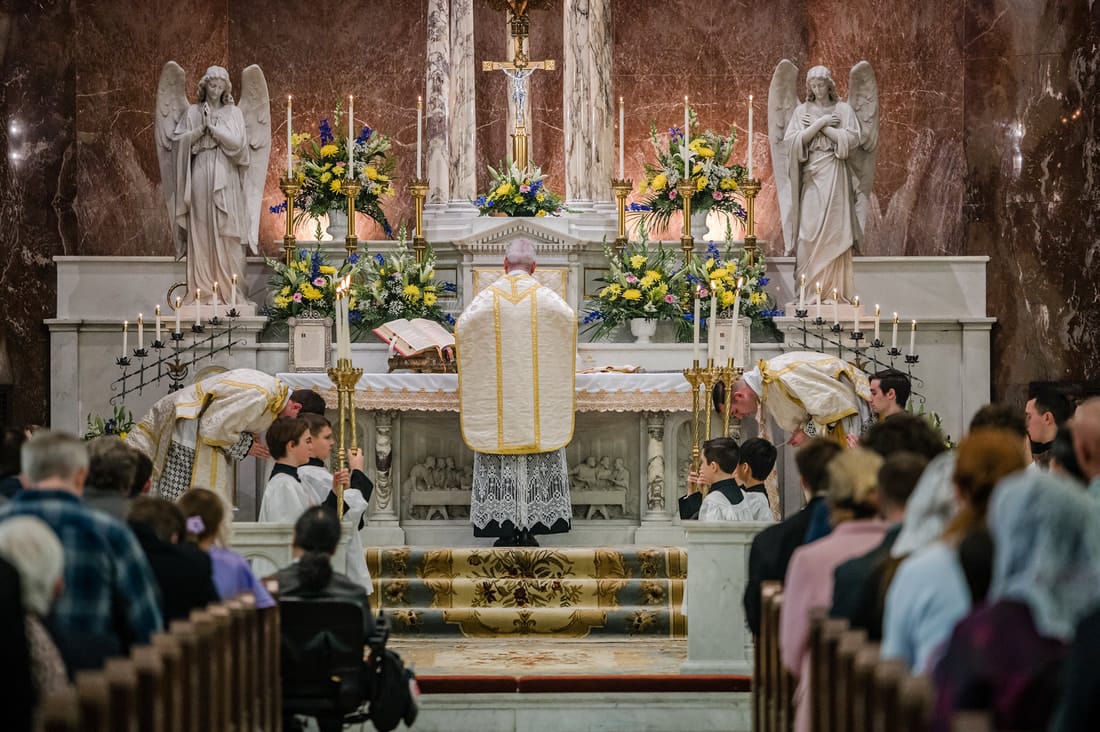
Maybe in our lifetime we will see the return to the full bow for the confiteor... dare we hope