To Dwell in the Father's House
------Part 1 (6/1)------
The summer has been a bit of a burden for me liturgically so far, but it has been self imposed. To start, I attended a three hour priestly ordination Mass followed by four Masses of Thanksgiving. For the next two weekends, I attended five Masses in total (one for Saturday morning, three Sunday Masses to help the servers at the parish I reside at, and a Traditional High Mass for my own personal devotion). It has been exhausting, and I hit a wall today. Even though I am known around the seminary for being obsessive over the Mass, I felt burnt out worshiping at Mass. After I got back from my final Mass today and relaxed for a bit, I felt a familiar, but non-regular nudge from the Lord to go pray. Usually when I sense this direct invitation, something powerful follows afterwards. Today, I just went to the chapel and poured out my frustrations to the Lord and how any sense of awe, wonder, mystery, and glory is completely numb within my soul. It was like a holy venting. I came away with no insight other than my own weakness and how I need to reground myself in the simple truths of the Christian life.
The contemplatives speak about a mysterious phenomenon that occurs with contemplative prayer. It is a place of dryness and dissatisfaction, yet we crave it more and more because we want to search for the Lord. It seems counterintuitive, but it is just how God decides to draw us deeper to Himself. This is what I think I experienced today in that visit to the chapel.
After my chapel time, I still felt this longing in my heart for God that hadn't been quenched. I decided to go on a walk and listen to one of my favorite preachers give a 1 hour talk on how he personally learned how to pray. I won't bore you with details of the talk, but he essentially witnessed to how we all play hide and go seek with God, except we secretly fear being found.
After years and years of sin and the consequences of other people's sin, we find ourselves completely closed off from God. One of my favorite images from the talk is that God wants to take our heart of stone and convert it into a heart of flesh. What does this mean for our insecurities though? This means that God wants to take our unbreakable hearts and turn them into breakable hearts. This seems so unsafe and scary when we really examine it.
Every single thing that we deem to be too shameful or scary to share with others is no longer able to be hidden. If we want to be healed and transformed, we must expose ourselves and let our hearts be woundable. This is such a hard concept for modern man to grasp, and it really isn't that hard to understand why.
Most of us grow up with a broken family of sorts. There are all times we can point to where our parents have hurt us in some way. There are things that we wished were true about our parents that aren't true. There are things that we wish we could share with our parents that we feel we can't. Because of this, our images of motherhood and fatherhood are wrong and hurt how we interpret the Father's gaze. I realized this especially today when this preacher said that we yearn to live in the Father's house...
///////////
I have written many posts about union with the bridegroom and how we need to live a sacrificial love that stops at no obstacle, but rarely do I write about my relationship with the Father... I won't speak about my relationship with my biological father, but we all know that nobody is perfect, including my father, so there are wounds that develop as a consequence. I look up to him in many ways, but he is a sinner just like myself.
The Father's house is an image that I don't reflect on much, but I probably should. I have spent a lot of time in my biological father's house, so I am aware of what aspects I like about it and what aspects I don't. I am so grateful that my family eats meals together at the dinner table whenever possible. This is a pretty simple concept, but I rarely imagine what it means to eat at the table with God the Father. Instead, it is natural for me to ask for help regarding various petitions or questions about discernment, but never do I simply spend time with Him as my "Dad."
The Father's house has a personal element that I am resistant to at first. When we gather at the table of the Lord at Mass, it is easy to hide in the midst of the congregation. The table in the Church doesn't feel as personal as the dinner table at my childhood home. There is a special quality to the dinner table at home that God the Father also wants to give to me.
-------Part 2 (7/26)-------
I am picking the draft of this post back up a few weeks later. I initially had a section planned about spiritual fatherhood, but I had left it blank. Now that I have returned from a friend's amazing wedding, I have some more specific thoughts. Normally what we all remember from a wedding is the beautiful couple, but this wedding was different for me. This may have been through some sort of distraction or fault of mine, but I couldn't take my eyes off of the celebrant priest. Perhaps this was the couple's goal because I know they wanted a God centered liturgy, but this was the first time I actually participated in it like that.
For context, this wedding was celebrated with all of the "controversial" options chosen. Instead of emotional hymns, they opted for the Gregorian Chant that the Church prescribes. Much of the Mass was celebrated in Latin. The altar faced Ad Orientem so the couple wasn't the focus. This sort of set the framework for the liturgy. What tied it all together was the celebrant. It sounds silly, but he simply preached the truth, celebrated the Mass reverently, and showed how he cared for his spiritual children.
I don't remember the specifics of the homily, but one part stuck out. He said to the couple something along the lines of: "The goal of marriage is not happiness, it is holiness. If you came here for love and happiness, then you will get divorced. If you came here for holiness, then you will get to heaven." It was an especially powerful sermon because the priest proclaimed it with a firm tone while not taking his eyes off of the couple. You could see the fatherly charity radiating from his soul. He did all of this while knowing that there were some recently divorced couples present at the wedding with their new "friends." I expressed my gratitude to him after the liturgy and he just said "I didn't say anything special. I just said the truth."
The other part of the Mass that uniquely stuck out to me was the blessing of the couple after the Roman Canon. The priest decided to use the "canonical fingers" which is when he keeps his thumb and index fingers pressed together until the end of the distribution of communion. This is done to prevent any particles / crumbs of the Eucharist from falling to the ground. What was super cool about this (which can't be done in the Old rite), is that he pressed his hands, holding fine particles of the Eucharist, against the couple's foreheads in order to bestow on them the blessing. It was such a clear symbol of the literal graces that were flowing from the Holy Sacrifice of the Mass on the Altar to the couple. He also gave the blessing with such priestly authority. You could tell he was pulling every stop possible to fill his children with grace.
If you ever read this Fr. John, thank you for your witness and service to Holy Mother Church.
///////
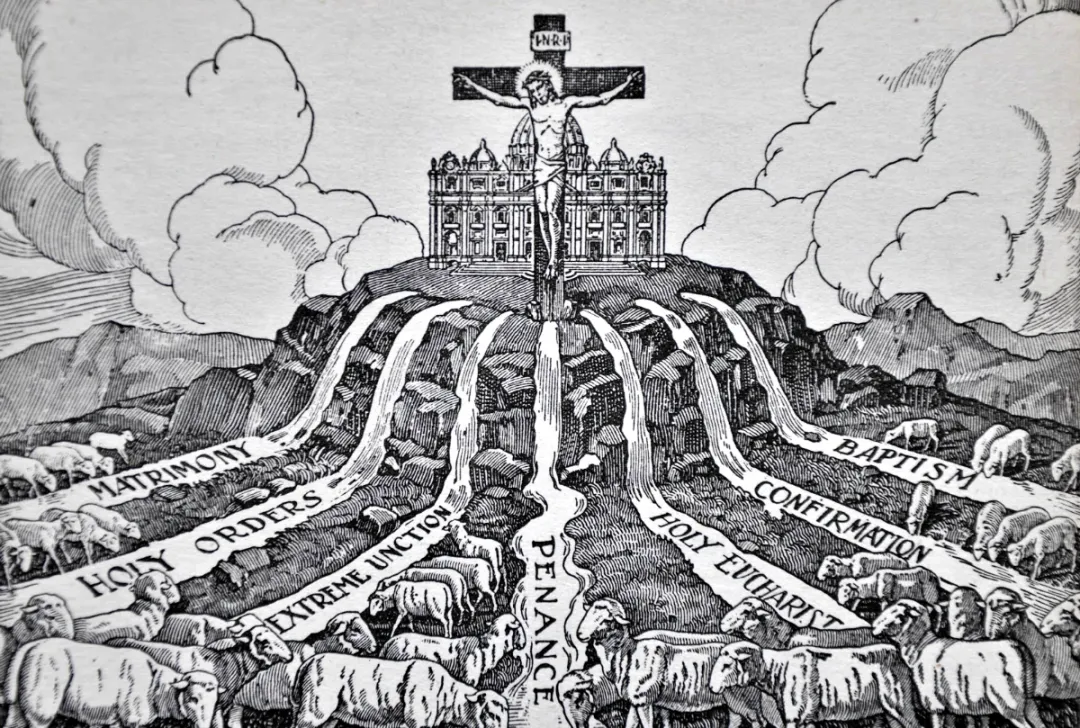
Fun fact: It is Church teaching that all graces received in the world are poured forth from the Sacrifice of Jesus Christ on Calvary, and hence all graces we receive flow also from the Holy Sacrifice of the Mass. This was the most visible sign of the graces of marriage that I have ever seen, and I will definitely try to use this posture if I am ordained one day.
"The Passion of Christ is the cause of grace by way of merit, by way of efficient causality, and by way of example.” (ST III, q. 48, a. 1)